Bengali Calendar July 2026 is one of the busiest months on the Bengali religious spread across two Bengali months — Ashar and Shrabon. It opens with the grand chariot procession of Rath Yatra on July 16, moves through the women-led devotion of Bipodtarini Puja on July 18 and 21, brings Lord Jagannath home again on Ulto Rath Yatra on July 24, marks the start of the four-month Chaturmas period on Devshayani Ekadashi (July 25), and closes with Guru Purnima on July 29 — a day of gratitude toward teachers and spiritual guides observed well beyond Bengal.
If you read our June 2026 Bengali Calendar guide, you’ll know Rath Yatra shifted later than usual this year because of an extra lunar month (Adhik Maas). July is where that shift lands, which is why this month is unusually festival-dense. Here’s a complete, date-by-date breakdown of everything worth knowing.
July 2026 Bengali Calendar — Festival & Holiday Table
| Date | Day | Festival / Observance |
|---|---|---|
| July 11, 2026 | Saturday | Second Saturday (bank holiday) |
| July 13, 2026 | Monday | Bhanu Jayanti (Darjeeling & Kalimpong) |
| July 16, 2026 | Thursday | Rath Yatra |
| July 18, 2026 | Saturday | Bipodtarini Puja (first date) |
| July 21, 2026 | Tuesday | Bipodtarini Puja (second date) |
| July 24, 2026 | Friday | Ulto Rath Yatra (Bahuda Yatra) |
| July 25, 2026 | Saturday | Devshayani Ekadashi + Fourth Saturday (bank holiday) |
| July 29, 2026 | Wednesday | Guru Purnima |
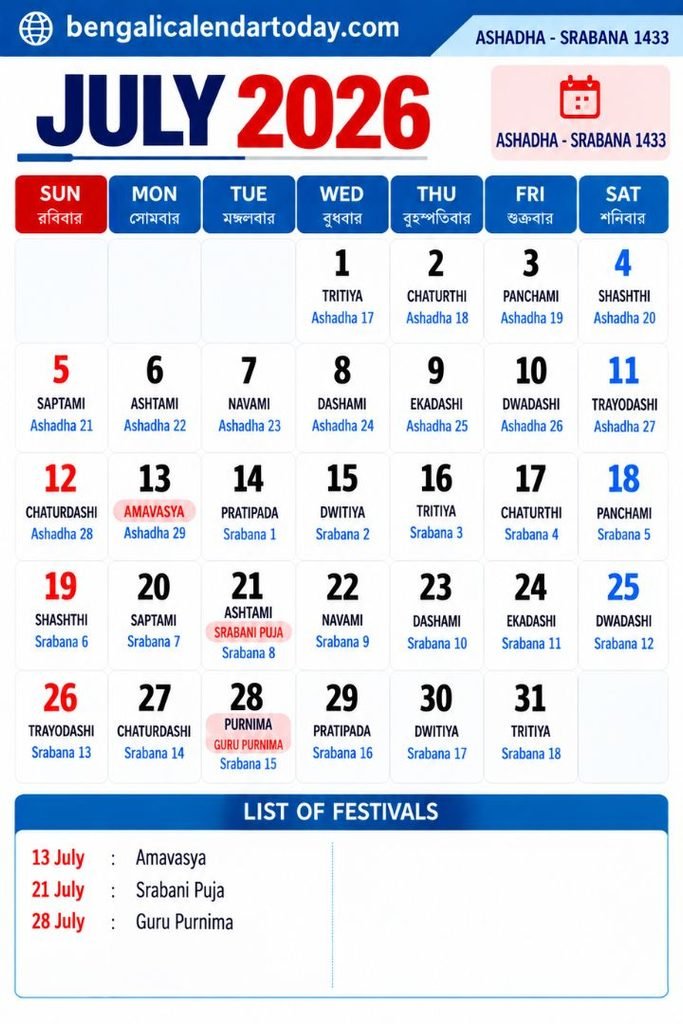
Bhanu Jayanti — July 13
Bhanu Jayanti falls on Monday, July 13, and is observed with real pride in Darjeeling and Kalimpong. The day marks the birth anniversary of Bhanubhakta Acharya, honoured as the first major poet of the Nepali language and best known for translating the Ramayana into Nepali. Schools and cultural associations across the Gorkha hills mark the day with recitations and community programmes celebrating Nepali literary heritage — a reminder that the Bengali Calendar region is home to more than one language tradition.
Rath Yatra — July 16
Rath Yatra 2026 falls on Thursday, July 16. Three towering wooden chariots carry Lord Jagannath, his brother Balabhadra, and his sister Subhadra through the streets, watched and pulled by devotees who believe the act of touching the chariot rope carries deep spiritual merit. Puri, Odisha hosts the principal celebration, but Bengal has its own long history with the festival — the Mahesh Rath Yatra in Hooghly district has run for more than six centuries and is one of the oldest chariot festivals in India outside Puri. Kolkata’s neighbourhood processions and ISKCON’s city-wide Rath Yatra draw enormous crowds every year, and in many Bengali homes it’s also simply a joyful family day, with children pulling toy chariots of their own.
Bipodtarini Puja — July 18 and 21
Bipodtarini Puja is observed on two separate dates this year, and which one a family follows usually comes down to regional tradition rather than personal choice — South Bengal households, particularly in Kolkata, Howrah, and Hooghly, may keep either the Saturday (July 18) or the Tuesday (July 21) fast depending on their local Panjika.
The name explains the goddess’s role: Bipod means danger, and Tarini means one who delivers a person from it. Bipodtarini, worshipped as a form of Durga, is invoked for protection from illness, accidents, and hardship. Married women typically observe a day-long fast, offer seasonal fruit and sweets, and tie a red-and-white protective thread on the wrist at the end of the puja — a small, visible mark of the vow that lasts through the year. Neighbourhood and community pujas are common, turning the observance into as much a social occasion as a religious one.
Ulto Rath Yatra (Bahuda Yatra) — July 24
Nine days after Rath Yatra, Lord Jagannath makes the return trip home. Ulto Rath Yatra — ulto meaning “reverse” in Bengali — falls on Friday, July 24, and retraces the same route back to the main temple from the Gundicha temple, where the deities are believed to have stayed as guests. Tradition holds that witnessing the return journey carries the same spiritual merit as witnessing the outward one, so the nine days in between are treated as a continuous devotional window, with kirtans and prasad distribution continuing throughout Bengal’s Rath Yatra communities.
Devshayani Ekadashi and the Start of Chaturmas — July 25
Saturday, July 25 is Devshayani Ekadashi, one of the more consequential dates on the whole Hindu calendar rather than just the Bengali one. It marks the point where Lord Vishnu is believed to begin a four-month period of cosmic rest, not waking again until Prabodhini Ekadashi in autumn. This period, called Chaturmas, is the reason you’ll notice very few wedding invitations, Griha Pravesh ceremonies, or Annaprashan functions scheduled between late July and early November — most families hold off on major auspicious events until Vishnu is believed to have “woken up” again. In its place, Chaturmas is treated as a season better suited to fasting, scripture reading, and charitable giving. This year, Devshayani Ekadashi also coincides with the month’s fourth Saturday, so it’s a double bank holiday date for banking purposes.
Guru Purnima — July 29
The month closes with Guru Purnima on Wednesday, July 29, the full moon day of Ashadha. It’s a day set aside for expressing gratitude to teachers, mentors, and spiritual guides, and it also honours Maharishi Ved Vyasa, traditionally credited with compiling the Vedas and authoring the Mahabharata. Bengal’s own contribution to this idea runs deep — the region produced Ramakrishna Paramhansa, Swami Vivekananda, and Rabindranath Tagore, all of whom are remembered as guiding figures well beyond religious circles. Ashrams, schools, and temples typically hold satsangs and lectures on the day, and many families use it simply as an occasion to thank the people who shaped them.
Ashar and Shrabon — July’s Two Bengali Months
July 2026 sits across two Bengali months, each with its own cultural flavour. Ashar, covering the first half of the month, is associated with the onset of monsoon rains and carries a strong emotional pull in Bengali poetry and music — Tagore’s monsoon compositions draw heavily on this month’s mood. Shrabon, beginning around July 18, is the month of the heaviest monsoon and is closely tied to Shiva worship, including the tradition of fasting on Shrabon Mondays. Together, these two months make July as much a cultural touchstone for Bengali identity as a religious one.
Frequently Asked Questions
When is Rath Yatra in July 2026? Rath Yatra falls on Thursday, July 16, 2026.
Why are there two dates for Bipodtarini Puja in 2026? Bipodtarini Puja falls on both July 18 and July 21 this year, and families follow whichever date matches their regional Panjika tradition — this is normal and not a sign of disagreement between calendars.
When does Chaturmas begin in 2026, and what does it mean for weddings? Chaturmas begins on Devshayani Ekadashi, July 25, 2026. Most Hindu families avoid weddings, housewarmings, and similar auspicious ceremonies from this date until Prabodhini Ekadashi in the autumn.
When is Guru Purnima in 2026? Guru Purnima falls on Wednesday, July 29, 2026, the full moon day of the Ashadha month.
What is Ulto Rath Yatra? Ulto Rath Yatra, or Bahuda Yatra, is Lord Jagannath’s return journey to the main temple after nine days at the Gundicha temple. In 2026, it falls on Friday, July 24.
How many bank holidays fall in July 2026? Four notable dates: the second Saturday (July 11), Rath Yatra (July 16, regional), the fourth Saturday coinciding with Devshayani Ekadashi (July 25), and Guru Purnima (July 29, regional).