For Bengali families in West Bengal, Tripura, Assam, Bangladesh and across the world, the Bengali calendar is part of everyday life. It tells you when the new year begins, when Durga Puja arrives, when a shop opens its new ledger, and when it is safe to book a wedding hall. This guide explains the Bengali Calendar 2026-2027 in plain language. You will find the full list of festivals and holidays, Ekadashi dates, Purnima and Amavasya days, Durga Puja schedules, wedding (Shubho Bibaho) dates and the key differences between the West Bengal and Bangladesh versions of the Bangla Calendar 2026-2027.
What Is the Bengali Calendar?
The Bengali calendar, called Bangabda (Bangla year), is the traditional calendar of Bengal. The year number is about 593 less than the Gregorian year once Poila Boishakh has passed, and 594 less before it. That is why most of 2026 falls in year 1433, while the first three and a half months of 2026 belong to year 1432.
Two ideas make the calendar easy to understand:
- The months follow the sun. Each Bengali month begins when the sun moves into a new zodiac sign (a Sankranti). This is why Poila Boishakh falls around 14 or 15 April every year.
- The festivals follow the moon. Ekadashi, Purnima, Amavasya, Durga Puja and Kali Puja are set by lunar days called tithis. The printed almanac that combines both systems is called the Panjika. Because lunar days do not match the Gregorian calendar, these festivals move from year to year.
Bengali Calendar 2026 PDF Free Download
In modern times many people want to download this calendar online, so that they can always keep it with them in their smartphone, tablet or laptop and can check the Muhurta or date anytime.
However, it’s important to clarify that the original ‘Bengali Calendar’ is a copyrighted publication. Their own printed version is sold in the market. Therefore, making a scanned copy of the entire original calendar available for free directly on the internet as a PDF may violate copyright laws.
However, for your convenience and information, we have compiled a detailed monthly calendar for the entire year 2026 and a list of major festivals below, compiled by our team based on Vedic calendars. You can bookmark this webpage without any worries, or save the entire Bengali Calendar as a PDF download (Print > Save as PDF) in your browser settings. This will serve as a complete digital calendar for you.
| Month | Information |
|---|---|
| Bengali Calendar January 2026 | Save as PDF |
| Bengali Calendar February 2026 | Save as PDF |
| Bengali Calendar March 2026 | Save as PDF |
| Bengali Calendar April 2026 | Save as PDF |
| Bengali Calendar May 2026 | Save as PDF |
| Bengali Calendar June 2026 | Save as PDF |
| Bengali Calendar July 2026 | Save as PDF |
| Bengali Calendar August 2026 | Save as PDF |
| Bengali Calendar September 2026 | Save as PDF |
| Bengali Calendar October 2026 | Save as PDF |
| Bengali Calendar November 2026 | Save as PDF |
| Bengali Calendar December 2026 | Save as PDF |
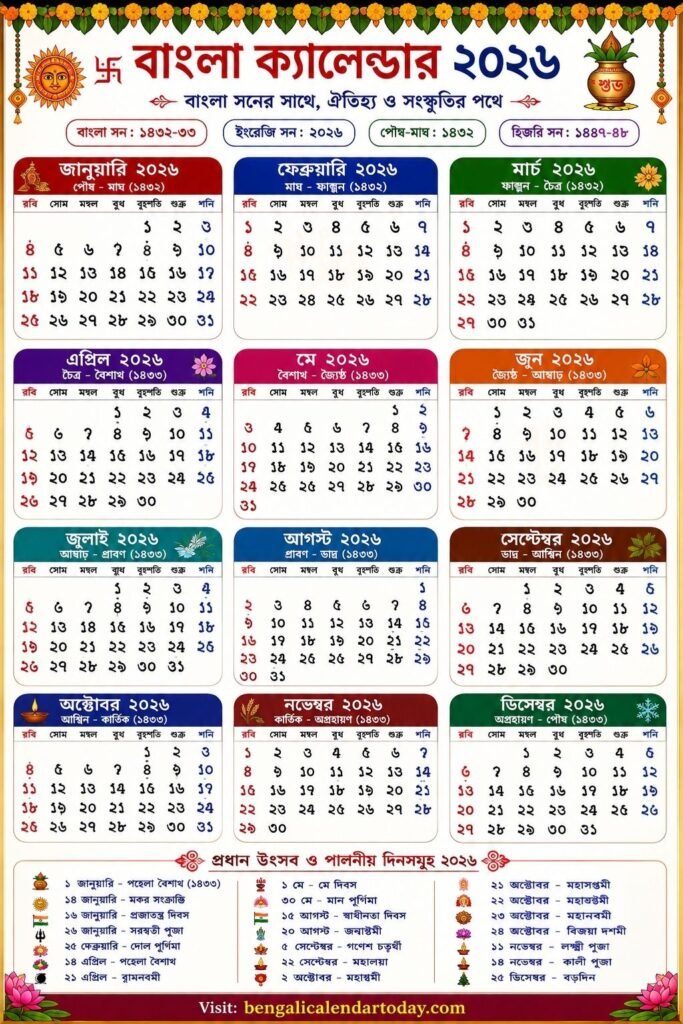
The 12 Bengali Months of Year 1433 (2026-2027)
The table below shows when each month begins. West Bengal dates are approximate and can differ by a day between panjikas. Bangladesh dates follow the fixed official calendar.
| Bengali Month | Season (Ritu) | Starts in West Bengal (approx.) | Starts in Bangladesh |
|---|---|---|---|
| Boishakh | Grishma (Summer) | 15 April 2026 | 14 April 2026 |
| Joishtho | Grishma (Summer) | 16 May 2026 | 15 May 2026 |
| Asharh | Borsha (Monsoon) | 16 June 2026 | 15 June 2026 |
| Shrabon | Borsha (Monsoon) | 17 July 2026 | 16 July 2026 |
| Bhadro | Shorot (Autumn) | 18 August 2026 | 16 August 2026 |
| Ashwin | Shorot (Autumn) | 18 September 2026 | 16 September 2026 |
| Kartik | Hemonto (Late Autumn) | 18 October 2026 | 17 October 2026 |
| Agrahayan | Hemonto (Late Autumn) | 17 November 2026 | 16 November 2026 |
| Poush | Sheet (Winter) | 17 December 2026 | 16 December 2026 |
| Magh | Sheet (Winter) | 15 January 2027 | 15 January 2027 |
| Falgun | Boshonto (Spring) | 13 February 2027 | 14 February 2027 |
| Choitro | Boshonto (Spring) | 15 March 2027 | 15 March 2027 |
| Boishakh 1434 | Grishma (Summer) | 15 April 2027 | 14 April 2027 |
Bengali Calendar 2026: Festivals and Holidays
This list is arranged for West Bengal. Dates for Islamic festivals depend on moon sighting and may move by a day.
| Date (2026) | Day | Festival or Occasion |
|---|---|---|
| 14 January | Wednesday | Poush Sankranti (Makar Sankranti). Some panjikas mark 15 January |
| 23 January | Friday | Saraswati Puja (Basant Panchami) and Netaji Subhas Chandra Bose Jayanti |
| 26 January | Monday | Republic Day |
| 15 February | Sunday | Maha Shivaratri |
| 21 February | Saturday | International Mother Language Day (8 Falgun in Bangladesh) |
| 3 March | Tuesday | Dol Jatra (Dol Purnima) |
| 14 April | Tuesday | Choitro Sonkranti and Charak, the last day of year 1432 |
| 15 April | Wednesday | Poila Boishakh, Bengali New Year 1433 (West Bengal and Tripura) |
| 1 May | Friday | May Day and Buddha Purnima |
| 9 May | Saturday | Rabindra Jayanti (25 Boishakh) |
| 16 July | Thursday | Rath Yatra |
| 25 July | Saturday | Devshayani Ekadashi, start of Chaturmas |
| 29 July | Wednesday | Guru Purnima |
| 15 August | Saturday | Independence Day |
| 28 August | Friday | Raksha Bandhan (Shravana Purnima) |
| 4 September | Friday | Janmashtami |
| 17 September | Thursday | Vishwakarma Puja |
| 2 October | Friday | Gandhi Jayanti |
| 10 October | Saturday | Mahalaya |
| 17 to 21 October | Saturday to Wednesday | Durga Puja (see the day-by-day table below) |
| 25 October | Sunday | Kojagari Lakshmi Puja |
| 8 November | Sunday | Kali Puja and Diwali |
| 11 November | Wednesday | Bhai Phonta (some panjikas mark 10 November) |
| 15 November | Sunday | Chhath Puja |
| 18 November | Wednesday | Jagaddhatri Puja |
| 20 November | Friday | Devutthana Ekadashi, end of Chaturmas (21 November for Vaishnavas) |
| 24 November | Tuesday | Kartik Purnima (Rash Purnima) |
| 25 December | Friday | Christmas |
Islamic festivals in 2026 are expected around 20 to 21 March (Eid-ul-Fitr), 27 May (Eid-ul-Adha) and 26 June (Muharram/Ashura), depending on the moon.
Durga Puja 2026 Dates (West Bengal)
The Government of West Bengal has notified the following puja-time holidays for 2026. Please note that Bengal marks Bijoya Dashami on 21 October, one day after the Dussehra date used in many North Indian calendars.
| Date (2026) | Day | Observance |
|---|---|---|
| 10 October | Saturday | Mahalaya |
| 15 October | Thursday | Maha Chaturthi |
| 16 October | Friday | Maha Panchami |
| 17 October | Saturday | Maha Shashthi (Bodhon in the evening) |
| 18 October | Sunday | Maha Saptami (Kolabou Puja) |
| 19 October | Monday | Maha Ashtami (Sandhi Puja at the Ashtami-Navami junction) |
| 20 October | Tuesday | Maha Navami |
| 21 October | Wednesday | Bijoya Dashami (Sindoor Khela and visarjan) |
| 25 October | Sunday | Kojagari Lakshmi Puja |
Bengali Calendar 2027: Festivals and Holidays
Dates for 2027 are calculated in advance. They are accurate for planning, but the West Bengal government and the Bengali panjikas confirm the final dates later in the year, so treat any festival date as possibly one day different.
| Date (2027) | Day | Festival or Occasion |
|---|---|---|
| 14 January | Thursday | Poush Sankranti (Makar Sankranti). Some panjikas mark 15 January |
| 23 January | Saturday | Netaji Subhas Chandra Bose Jayanti |
| 26 January | Tuesday | Republic Day |
| 11 February | Thursday | Saraswati Puja (Basant Panchami) |
| 21 February | Sunday | International Mother Language Day |
| 6 March | Saturday | Maha Shivaratri |
| 21 to 22 March | Sunday to Monday | Dol Purnima and Holi (colours on 22 March) |
| 26 March | Friday | Independence Day of Bangladesh (12 Choitro) |
| 14 April | Wednesday | Choitro Sonkranti and Charak (West Bengal), Pohela Boishakh (Bangladesh) |
| 15 April | Thursday | Poila Boishakh, Bengali New Year 1434 (West Bengal and Tripura) |
| 1 May | Saturday | May Day |
| 9 May | Sunday | Rabindra Jayanti (25 Boishakh) |
| 19 May | Wednesday | Buddha Purnima |
| 5 July | Monday | Rath Yatra |
| 14 July | Wednesday | Devshayani Ekadashi, start of Chaturmas |
| 18 July | Sunday | Guru Purnima |
| 15 August | Sunday | Independence Day |
| 16 August | Monday | Raksha Bandhan (Shravana Purnima) |
| 25 August | Wednesday | Janmashtami |
| 17 September | Friday | Vishwakarma Puja |
| 28 to 29 September | Tuesday to Wednesday | Mahalaya (approx.) |
| 5 to 9 October | Tuesday to Saturday | Durga Puja (Shashthi to Bijoya Dashami, approx.) |
| 14 October | Thursday | Kojagari Lakshmi Puja (approx.) |
| 28 October | Thursday | Kali Puja and Diwali (approx.) |
| 30 October | Saturday | Bhai Phonta (approx.) |
| 4 November | Thursday | Chhath Puja |
| 7 to 8 November | Sunday to Monday | Jagaddhatri Puja (approx.) |
| 10 November | Wednesday | Devutthana (Prabodhini) Ekadashi, end of Chaturmas |
| 13 November | Saturday | Kartik Purnima (Rash Purnima, approx.) |
| 16 December | Thursday | Victory Day of Bangladesh (1 Poush) |
| 25 December | Saturday | Christmas |
Islamic festivals in 2027 are expected around 9 to 10 March (Eid-ul-Fitr) and 16 to 17 May (Eid-ul-Adha), depending on moon sighting.
Durga Puja 2027 Dates (Calculated)
| Date (2027) | Day | Observance |
|---|---|---|
| 28 to 29 September | Tuesday to Wednesday | Mahalaya (approx.) |
| 5 October | Tuesday | Maha Shashthi |
| 6 October | Wednesday | Maha Saptami |
| 7 October | Thursday | Maha Ashtami |
| 8 October | Friday | Maha Navami |
| 9 October | Saturday | Bijoya Dashami |
| 14 October | Thursday | Kojagari Lakshmi Puja (approx.) |
Ekadashi Dates 2026
Ekadashi comes twice a month, once in each half of the lunar cycle. The dates below follow the Smarta tradition for New Delhi. Vaishnava (ISKCON) devotees and some Bengali panjikas may observe the fast one day later.
| Date (2026) | Ekadashi |
|---|---|
| 14 January | Shattila Ekadashi |
| 29 January | Jaya Ekadashi |
| 13 February | Vijaya Ekadashi |
| 27 February | Amalaki Ekadashi |
| 15 March | Papamochani Ekadashi |
| 29 March | Kamada Ekadashi |
| 13 April | Varuthini Ekadashi |
| 27 April | Mohini Ekadashi |
| 13 May | Apara Ekadashi |
| 27 May | Padmini Ekadashi (Adhik month) |
| 11 June | Parama Ekadashi (Adhik month) |
| 25 June | Nirjala Ekadashi |
| 10 July | Yogini Ekadashi |
| 25 July | Devshayani Ekadashi |
| 9 August | Kamika Ekadashi |
| 23 August | Shravana Putrada Ekadashi |
| 7 September | Aja Ekadashi |
| 22 September | Parsva (Parivartini) Ekadashi |
| 6 October | Indira Ekadashi |
| 22 October | Papankusha Ekadashi |
| 5 November | Rama Ekadashi |
| 20 November | Devutthana (Prabodhini) Ekadashi |
| 4 December | Utpanna Ekadashi |
| 20 December | Mokshada Ekadashi |
Ekadashi Dates 2027
| Date (2027) | Ekadashi | Vaishnava date (if different) |
|---|---|---|
| 3 January | Saphala Ekadashi | Same |
| 19 January | Putrada Ekadashi | Same |
| 2 February | Shattila Ekadashi | Same |
| 17 February | Jaya Ekadashi | Same |
| 3 March | Vijaya Ekadashi | 4 March |
| 18 March | Amalaki Ekadashi | 19 March |
| 2 April | Papamochani Ekadashi | 3 April |
| 16 April | Kamada Ekadashi | 17 April |
| 2 May | Varuthini Ekadashi | Same |
| 16 May | Mohini Ekadashi | Same |
| 1 June | Apara Ekadashi | Same |
| 14 June | Nirjala Ekadashi | 15 June |
| 30 June | Yogini Ekadashi | Same |
| 14 July | Devshayani Ekadashi | Same |
| 29 July | Kamika Ekadashi | 30 July |
| 12 August | Shravana Putrada Ekadashi | 13 August |
| 28 August | Aja Ekadashi | Same |
| 11 September | Parivartini Ekadashi | Same |
| 26 September | Indira Ekadashi | Same |
| 11 October | Papankusha Ekadashi | Same |
| 25 October | Rama Ekadashi | 26 October |
| 10 November | Prabodhini Ekadashi | Same |
| 24 November | Utpanna Ekadashi | Same |
| 9 December | Mokshada Ekadashi | 10 December |
| 23 December | Saphala Ekadashi | Same |
Purnima and Amavasya Dates 2026-2027
Full-moon (Purnima) and new-moon (Amavasya) days are important for fasting, ancestor offerings and puja planning.
| Date | Occasion |
|---|---|
| 3 March 2026 | Phalguna Purnima (Dol Purnima) |
| 2 April 2026 | Chaitra Purnima |
| 1 May 2026 | Buddha Purnima |
| 29 June 2026 | Jyeshtha Purnima (Snana Purnima) |
| 14 July 2026 | Ashadha Amavasya |
| 29 July 2026 | Guru Purnima |
| 28 August 2026 | Shravana Purnima |
| 10 October 2026 | Mahalaya Amavasya |
| 25 October 2026 | Kojagari Purnima (Sharad Purnima) |
| 8 November 2026 | Kali Puja Amavasya |
| 24 November 2026 | Kartik Purnima |
| 6 February 2027 | Mauni (Magha) Amavasya |
| 20 February 2027 | Magha Purnima |
| 21 March 2027 | Phalguna Purnima (Dol Purnima) |
| 20 April 2027 | Chaitra Purnima |
| 19 May 2027 | Buddha Purnima |
| 18 July 2027 | Guru Purnima |
| 16 August 2027 | Shravana Purnima |
| 28 to 29 September 2027 | Mahalaya Amavasya (approx.) |
| 14 October 2027 | Kojagari Purnima (approx.) |
| 28 October 2027 | Kali Puja Amavasya (approx.) |
| 13 November 2027 | Kartik Purnima (approx.) |
Chaturmas and the Wedding Season
Chaturmas is a four-month period that starts on Devshayani Ekadashi and ends on Devutthana (Prabodhini) Ekadashi. During this time, Lord Vishnu is believed to rest, and many families avoid weddings and housewarmings.
| Year | Chaturmas begins | Chaturmas ends |
|---|---|---|
| 2026 | 25 July (Devshayani Ekadashi) | 20 November (Devutthana Ekadashi) |
| 2027 | 14 July (Devshayani Ekadashi) | 10 November (Prabodhini Ekadashi) |
This is the reason why the Bengali wedding season is quiet in Shrabon, Bhadro, Ashwin and most of Kartik, and busy again from late November.
Shubho Bibaho: Bengali Wedding Dates 2026-2027
In Bengali culture, a wedding date is fixed only after the Panjika is checked. Families look at the tithi, the nakshatra and the horoscopes of the bride and groom. Many families also avoid certain months, such as Poush and Choitro, although customs differ from family to family.
The dates below were reported in a published Bengali Panjika-based wedding guide. They are an aid for early planning only. Your family priest must confirm the exact date and time (lagna).
| Month | Reported auspicious dates |
|---|---|
| November 2026 | 20, 21, 24, 25 |
| December 2026 | 2, 3, 4, 12 |
| January 2027 | 14, 15, 18, 24, 26, 31 |
| February 2027 | 2, 3, 9, 10, 11, 14, 15, 21, 22, 25, 26, 27, 28 |
| March 2027 | 1, 2, 3, 4, 10, 11, 14, 15 |
The list for November and December 2026 may not be complete. April to December 2027 dates will be easier to confirm closer to the date once the 1434 panjikas are released.
Bangladesh National Days in the Bangla Calendar
Bangladesh uses fixed dates, so each national day always falls on the same Bengali date.
| Gregorian date | Bengali date | Occasion |
|---|---|---|
| 21 February | 8 Falgun | Shaheed Dibas and International Mother Language Day |
| 26 March | 12 Choitro | Independence Day |
| 14 April | 1 Boishakh | Pohela Boishakh (Bengali New Year) |
| 1 May | 18 Boishakh | May Day |
| 16 December | 1 Poush | Victory Day |
| 25 December | 10 Poush | Christmas Day |
West Bengal vs Bangladesh: Two Versions of the Bangla Calendar
If you search for “Bangla Calendar 2026-2027” from Dhaka or Kolkata, you may see slightly different dates. That is not an error. The two regions follow different rules.
| Feature | West Bengal and Tripura | Bangladesh |
|---|---|---|
| Poila Boishakh 2026 | 15 April 2026 | 14 April 2026 |
| Poila Boishakh 2027 | 15 April 2027 | 14 April 2027 |
| How months start | The day after the Sankranti, so months vary from 29 to 32 days | Fixed Gregorian dates under the Bangla Academy reform |
| Month lengths | Change every year | First six months have 31 days, the next six have 30 days, and Falgun has 29 days (30 in a leap year) |
| Religious festivals | Set by the Bengali Panjika (tithi based) | Hindu festivals follow the panjika, while national days are fixed |
| Example of a fixed date | Not applicable | 21 February is always 8 Falgun, and 16 December is always 1 Poush |
Frequently Asked Questions
What is the Bengali year for 2026-2027? The Bengali year 1433 runs from 15 April 2026 to 14 April 2027 in West Bengal, and from 14 April 2026 to 13 April 2027 in Bangladesh. Year 1434 begins in April 2027.
When is Poila Boishakh in 2026 and 2027? In West Bengal and Tripura, Poila Boishakh is on Wednesday, 15 April 2026 and Thursday, 15 April 2027. In Bangladesh, Pohela Boishakh is on 14 April in both years.
Why do West Bengal and Bangladesh celebrate the new year on different days? Bangladesh adopted a revised calendar with fixed dates, so Pohela Boishakh is always 14 April. West Bengal never adopted the reform and still follows the sun-based Sankranti rule, which usually gives 15 April.
When is Durga Puja in 2026? Durga Puja 2026 in West Bengal runs from Maha Shashthi on 17 October to Bijoya Dashami on 21 October. Mahalaya falls on 10 October.
When is Durga Puja in 2027? Durga Puja 2027 is calculated for about 5 to 9 October, from Maha Shashthi to Bijoya Dashami. Confirm with the 1434 panjika.
When is Kali Puja in 2026 and 2027? Kali Puja falls on Sunday, 8 November 2026. For 2027, it is calculated for about 28 October.
Is the Bengali calendar solar or lunar? The months follow the sun, so Poila Boishakh stays close to 14 or 15 April. The festivals follow the moon, so Durga Puja, Kali Puja, Ekadashi and Purnima change dates every year.
How many Ekadashi are there in 2026 and 2027? The lists above show 24 Ekadashi dates in the 2026 calendar year and 25 in 2027, because Saphala Ekadashi falls in both January and December 2027.
Why do some websites show different festival dates? Tithis begin and end at different clock times, so a festival can change by a day depending on the city, the time zone and the panjika school followed. Smarta and Vaishnava traditions can also differ for Ekadashi.
Are weddings allowed during Chaturmas? Traditionally, families avoid weddings during Chaturmas. In 2026 it runs from 25 July to 20 November, and in 2027 from 14 July to 10 November.
When is Rabindra Jayanti? Rabindra Jayanti is observed on 25 Boishakh. That is Saturday, 9 May 2026 and Sunday, 9 May 2027.
Where can I find the official West Bengal holiday list? The state government notifies the public holiday list each year through its Finance Department. Dates in this guide for 2026 follow that notification, and the 2027 dates should be checked against the next official list.
Conclusion
The Bengali calendar for 2026-2027 is full of meaningful dates, from Poila Boishakh 1433 on 15 April 2026 to Durga Puja in October, Kali Puja in November and the start of the new year 1434 on 15 April 2027. Use the tables above to plan festivals, fasts, travel and weddings early. For ceremonies that depend on exact timing, always confirm with your family priest or a printed Bengali Panjika for your city.