If you’re searching for the Bengali Calendar February 2026 (বাংলা ক্যালেন্ডার ফেব্রুয়ারি ২০২৬), you’ve landed in the right place. February is the shortest month on the Gregorian calendar, but in the Bangla Panjika it covers two full Bengali months packed with some of the year’s most significant observances.
This edition of the Bengali Calendar February 2026 spans the closing days of Magh (মাঘ), the 10th month of Bangabda 1432, and the opening weeks of Phalgun (ফাল্গুন), the 11th month. Together, these two late-winter months carry the sacred bathing ritual of Magha Purnima, the year’s grandest night of Shiva worship on Maha Shivratri, two important Ekadashi fasts, the solemn ancestor-worship of Phalguna Amavasya, and the deeply emotional observance of International Mother Language Day.
Bengali Calendar February 2026 — Month at a Glance
| Detail | Information |
|---|---|
| Bengali Month (till ~12–13 Feb) | Magh (মাঘ), 10th month, Bangabda 1432 |
| Bengali Month (from ~13 Feb) | Phalgun (ফাল্গুন), 11th month, Bangabda 1432 |
| Bengali Year | Bangabda 1432 |
| Calendar Basis | Luni-solar Panjika, solar month boundaries (Sankranti-based) |
| Season | Shishir (late winter) moving into Basanta (spring) |
| Major Festival | Maha Shivratri — 15 February |
| National Observance | International Mother Language Day — 21 February |
| Bank Holidays | 14 February (2nd Saturday), 28 February (4th Saturday) |
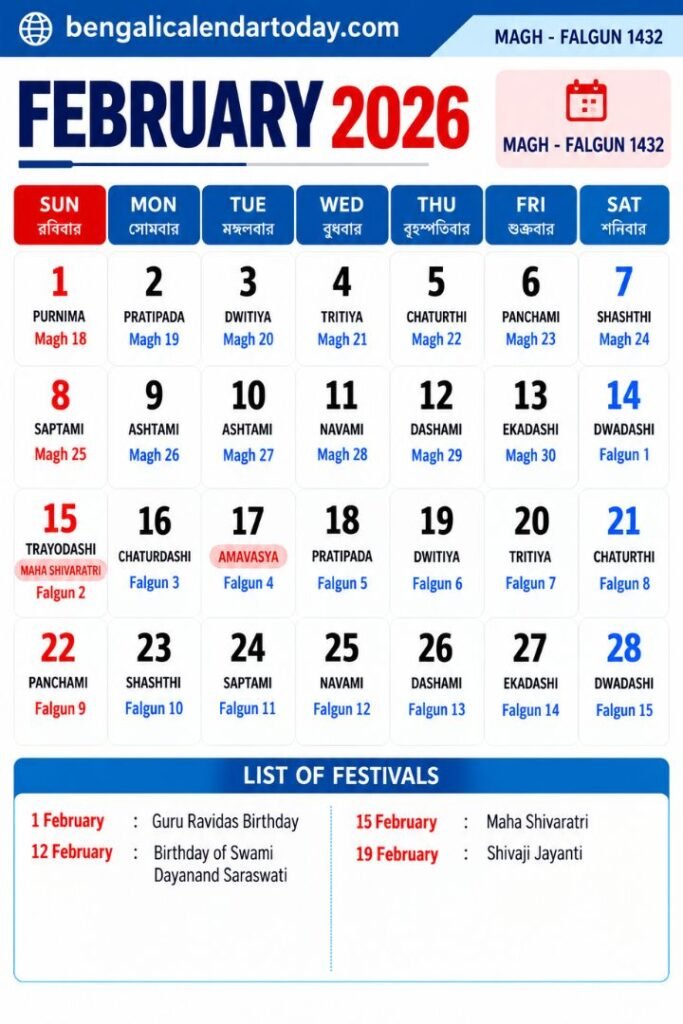
Note: Bengali month boundaries follow the Sun’s solar transit (Sankranti), while individual vrat names like “Magh Krishna Ekadashi” follow the pan-Indian lunisolar Panchang — so a festival can carry a Magh label even close to the Magh–Phalgun changeover. Always confirm exact local timings with a current-year Panjika.
Complete Day-by-Day Festival & Holiday Table
| Date | Day | Festival / Holiday | Type |
|---|---|---|---|
| 1 February 2026 | Sunday | Magha Purnima (Snan & Daan) | Full Moon — Magh |
| 13 February 2026 | Friday | Vijaya Ekadashi | Vrat — Magh Krishna Ekadashi |
| 14 February 2026 | Saturday | Second Saturday | Bank Holiday |
| 15 February 2026 | Sunday | Maha Shivratri | Major Festival |
| 17 February 2026 | Tuesday | Phalguna Amavasya | New Moon — Ancestor Rites |
| 21 February 2026 | Saturday | International Mother Language Day (Shaheed Dibash) | National / Cultural Observance |
| 27 February 2026 | Friday | Amalaki Ekadashi | Vrat — Phalgun Shukla Ekadashi |
| 28 February 2026 | Saturday | Fourth Saturday | Bank Holiday |
Festival-by-Festival Guide
1. Magha Purnima — 1 February 2026 (Sunday)
The final full moon of Magh is one of the most meritorious bathing days of the entire Hindu year. Classical texts describe the whole month of Magh as auspicious for pre-dawn river baths, and Magha Purnima marks its culmination — devotees take a holy dip before sunrise, offer water to the sun, and give alms to the poor. Many Bengali households also perform Satyanarayan Puja on this day, and it traditionally closes the month-long Magh Snan vow some devotees observe along the Ganga.
2. Vijaya Ekadashi — 13 February 2026 (Friday)
Vijaya Ekadashi falls on the eleventh day of Magh’s dark fortnight. Although the Ekadashi tithi technically begins on the afternoon of 12 February, the fast itself is observed the next day, since Hindu vrats follow the sunrise (udaya) tithi rather than the tithi prevailing at any other hour — a distinction worth knowing if you’ve seen this date listed differently elsewhere.
The name Vijaya means “victory,” and the day is linked to a dramatic episode from the Ramayana: before crossing the ocean to Lanka, Lord Rama is said to have observed this fast on the advice of sage Bakadalbhya, after which his campaign against Ravana succeeded. Devotees today observe Vijaya Ekadashi seeking the strength to overcome major obstacles — legal, financial, or personal.
3. Maha Shivratri — 15 February 2026 (Sunday)
Maha Shivratri is the single most important night of Shiva worship in the year, falling on the Chaturdashi tithi of Phalgun’s dark fortnight. Unlike the monthly Shivratri observed every lunar month, this “Great Night” is marked by a full day-and-night fast, four-prahar puja through the night, and Rudrabhishek with milk, water, honey, and bael leaves at Shiva temples. The most sacred window — Nishita Kaal, believed to be the hour of Shiva’s manifestation — falls close to midnight and shifts by several minutes across cities, so check a location-specific Panchang for the precise time near you.
4. Phalguna Amavasya — 17 February 2026 (Tuesday)
The new moon that opens Phalgun is traditionally reserved for Pitru Tarpan — offerings of water, black sesame, and food to one’s ancestors. Falling just two days after Maha Shivratri, this Amavasya is considered an especially reflective period in the Bengali Panjika, when households often perform Shraddha rites for departed family members and visit riverbanks for a ritual bath before making offerings.
5. International Mother Language Day — 21 February 2026 (Saturday)
No date in the Bengali calendar carries more emotional weight than 21 February. It commemorates the events of 21 February 1952 in Dhaka, when students and activists protesting the imposition of Urdu as the sole state language of then East Pakistan were fired upon by police. Several young protesters lost their lives defending the right to speak and study in Bengali. UNESCO recognised the date as International Mother Language Day in 1999, and it is observed today as Shaheed Dibash — Martyrs’ Day — with processions to the Shaheed Minar, recitations, and cultural programmes across Bengal and Bangladesh.
6. Amalaki Ekadashi — 27 February 2026 (Friday)
Amalaki Ekadashi, observed on Phalgun’s bright-fortnight eleventh day, is unusual among Ekadashis because a tree — the Amla, or Indian gooseberry — is worshipped as the object of devotion rather than an idol. According to the Padma Purana, Lord Vishnu is believed to reside within the Amla tree during Phalgun, and devotees circumambulate and water the tree as part of the day’s rituals. In Varanasi, the same tithi is celebrated as Rangbhari Ekadashi, marking the traditional start of the Holi season.
Bank Holidays in February 2026
| Date | Day | Holiday |
|---|---|---|
| 14 February 2026 | Saturday | Second Saturday (RBI-notified) |
| 28 February 2026 | Saturday | Fourth Saturday (RBI-notified) |
Both banking holidays this month fall on Saturdays, so no regular weekday closures are expected. UPI, IMPS, and ATM services generally continue on bank holidays, though NEFT/RTGS branch processing and cheque clearing may pause — plan larger transfers around these dates. Some West Bengal bank branches may also observe reduced hours on Maha Shivratri (15 February); check locally if you have an urgent transaction.
Ekadashi Dates at a Glance
| Date | Ekadashi | Paksha | Focus |
|---|---|---|---|
| 13 February 2026 | Vijaya Ekadashi | Magh, Krishna Paksha | Overcoming obstacles |
| 27 February 2026 | Amalaki Ekadashi | Phalgun, Shukla Paksha | Amla tree worship |
Parana (fast-breaking) times vary by city and are best confirmed a day in advance through a local Panchang, since breaking the fast outside the correct window is considered to reduce its merit.
Magh and Phalgun: The Character of Late-Winter Bengal
Magh, the tenth month, sits at the coldest point of the Bengali year — remembered in folk speech as Maghi thanda, the sharpest chill of the season. This cold is treated as an opportunity rather than a hardship: pre-dawn river baths through Magh are considered especially meritorious, building up to Magha Purnima.
Phalgun, the eleventh month, is where winter visibly loosens its grip. Palash trees begin flowering in deep orange-red, days lengthen, and the cultural mood turns toward anticipation — Phalgun leads into Dol Purnima (Holi) and, eventually, into Poila Boishakh, the Bengali New Year that follows two months later.
Frequently Asked Questions
Q1. Which Bengali months does February 2026 cover?
February 2026 spans the closing part of Magh and the opening part of Phalgun, both within Bangabda 1432.
Q2. When is Maha Shivratri in 2026?
Maha Shivratri falls on Sunday, 15 February 2026, on the Chaturdashi tithi of Phalgun’s Krishna Paksha.
Q3. When is Magha Purnima in February 2026?
Magha Purnima falls on Sunday, 1 February 2026, marking the final full moon of Magh month.
Q4. What are the Ekadashi dates in February 2026?
There are two: Vijaya Ekadashi on 13 February (Magh Krishna Paksha) and Amalaki Ekadashi on 27 February (Phalgun Shukla Paksha).
Q5. Why is 21 February significant for Bengalis?
It is International Mother Language Day, commemorating the 1952 Language Movement martyrs of Dhaka and honouring the right to learn and speak in one’s mother tongue — observed as Shaheed Dibash across Bengal and Bangladesh.
Q6. Are there bank holidays in February 2026?
Yes — 14 February (second Saturday) and 28 February (fourth Saturday) are RBI-notified bank holidays; both fall on weekends this year.
Conclusion
The Bengali Calendar for February 2026 packs unusual significance into 28 days — a full-moon pilgrimage on the 1st, two Ekadashi fasts bracketing the month, the grandest night of Shiva worship on the 15th, ancestral remembrance on the 17th, and the unmatched cultural weight of Mother Language Day on the 21st. Whether you’re planning a vrat, a puja, or simply want to understand what’s being observed around you this month, keeping this Panjika handy will help you follow Magh and Phalgun 2026 with the timing they deserve. For city-specific puja muhurats, always cross-check with a local Panchang closer to each date.