The Bengali Calendar January 2026 opens the year with a distinctive blend of spiritual devotion, harvest celebration, literary tradition, and national pride that is uniquely Bengali. While January may be the first month in the Gregorian calendar, in the Bangla Panjika 1432, it falls within the final stretch of the Bengali year — spanning the sacred winter months of Poush (পৌষ) and Magh (মাঘ).
For Bengali families in West Bengal, Bangladesh, and the global diaspora, January 2026 is anchored by some of the most beloved annual observances. Poush Sankranti (Makar Sankranti) on January 14 draws millions of pilgrims to the shores of Sagar Island for the Gangasagar Mela — one of the largest religious gatherings in the world. Saraswati Puja on January 23 transforms every school, college, and neighborhood into a temple of learning and beauty. Netaji Subhas Chandra Bose Jayanti on January 23 fills the state with patriotic pride, and Republic Day on January 26 reminds every citizen of the democratic foundation on which modern India stands.
What Is the Bengali Calendar (Bangla Panjika)?
The Bengali Calendar, known in everyday life as the Bangla Panjika or Bongabdo, is a traditional lunar-solar almanac that has governed Bengali cultural, religious, and community life for centuries. It is the primary reference followed by Bengali Hindu families across West Bengal, Bangladesh, Tripura, Assam, and wherever Bengali communities have made their home worldwide.
Bengali Calendar January 2026 – Month at a Glance
Here is the complete overview of all major festivals, public holidays, and important observances in the Bengali Calendar for January 2026:
| Date | Day | Festival / Observance | Category |
|---|---|---|---|
| January 1, 2026 | Thursday | New Year’s Day (Gregorian) | General Observance |
| January 10, 2026 | Saturday | Second Saturday | Banking Holiday |
| January 13, 2026 | Tuesday | Paush Purnima | Religious Full Moon |
| January 14, 2026 | Wednesday | Poush Sankranti / Makar Sankranti | Major Bengali Festival |
| January 23, 2026 | Friday | Saraswati Puja / Basant Panchami + Netaji Jayanti | Cultural + State Holiday |
| January 24, 2026 | Saturday | Fourth Saturday | Banking Holiday |
| January 26, 2026 | Monday | Republic Day | National Public Holiday |
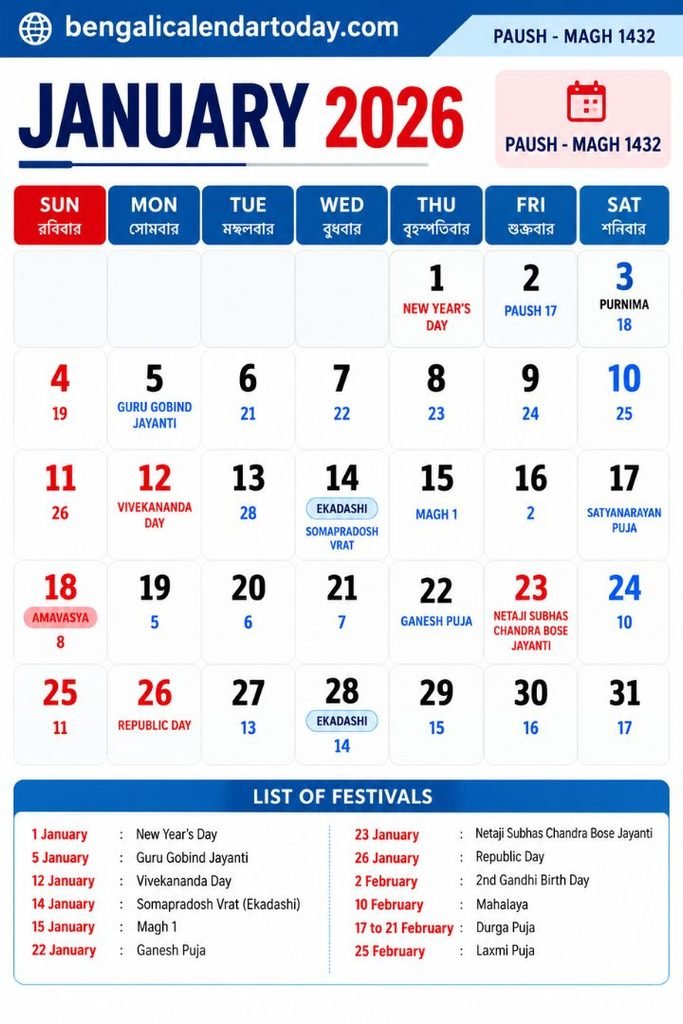
Bengali Months in January 2026 – Poush and Magh
January 2026 spans two consecutive months in the Bangla Panjika 1432:
| Bengali Month | Gregorian Period | Character |
|---|---|---|
| Poush (পৌষ) | Mid-December to January 14 | Deep winter, harvest, Sankranti |
| Magh (মাঘ) | January 14 onwards | Cold season, Saraswati Puja, learning |
Poush is the Bengali month most associated with winter’s peak — misty mornings, date palm jaggery (khejur gur), the harvest of winter crops, and the warm family tradition of making pithe-puli (traditional rice cakes). The month ends with the grand celebration of Poush Sankranti on January 14.
Magh begins at Sankranti and carries a gentler, more studious energy. It is the month of Saraswati Puja — the worship of the Goddess of learning — making it particularly beloved among students and educational institutions. Bengali poets and writers have associated Magh with a quiet, contemplative beauty, as the harshest of winter softens and the first whispers of approaching spring begin to stir.
Together, Poush and Magh give January 2026 a dual character — the joyful warmth of harvest and family traditions transitioning into the elegant, knowledge-celebrating spirit of Magh.
Poush Sankranti (Makar Sankranti) 2026 – January 14
Poush Sankranti 2026 falls on Wednesday, January 14 — and in Bengal, this day is considered one of the most auspicious and emotionally significant of the entire year. Known nationally as Makar Sankranti, this date marks the sun’s astronomical transition into the zodiac sign of Capricorn (Makar) — a celestial event that has been observed and celebrated across India for thousands of years.
In Bengali tradition, this day is called Poush Sankranti and carries a deeply domestic, harvest-rooted energy. The entire month of Poush leads up to this culminating celebration:
- Pithe-Puli Making: Bengali households come alive with the making of pithe — traditional sweet rice cakes filled with date palm jaggery, coconut, and sesame. The varieties are numerous, and every family has its treasured recipes. Making and sharing pithe on Poush Sankranti is a ritual of love, community, and cultural continuity
- Sacred Bathing (Punya Snan): Early morning dips in rivers, ponds, and sacred water bodies are undertaken with great devotion. The belief is that bathing in natural water on Sankranti day cleanses accumulated sins and brings the bather blessings for the year ahead
- Temple Worship: Temples across Bengal hold special puja ceremonies on this morning, drawing large community gatherings that reinforce neighborhood bonds
- Offerings to the Sun: As Makar Sankranti marks the sun’s northward journey (Uttarayan), prayers and offerings to Surya (the Sun God) are an integral part of the day’s observances
For Bengali families, Poush Sankranti is one of those rare calendar moments when the personal, familial, and spiritual all converge in a single warm, sweet, and sunlit day.
Gangasagar Mela 2026 – The Sacred Pilgrimage
The Gangasagar Mela 2026 takes place on Makar Sankranti — January 14 — at Sagar Island (Sagardwip) at the southernmost tip of West Bengal, where the sacred river Ganga meets the vast expanse of the Bay of Bengal.
This annual pilgrimage is one of the largest human gatherings in the world — rivaling even the Kumbh Mela in terms of sheer numbers. Millions of Hindu pilgrims from across India, Nepal, and the global Hindu diaspora travel to this remote island to take the sacred dip at the Sangam (confluence of river and sea) on Makar Sankranti morning.
The famous Sanskrit saying “Sabe teertha baar baar, Ganga Sagar ek baar” — which translates as “You can visit every pilgrimage site multiple times, but Gangasagar only once” — reflects the supreme spiritual significance attributed to this site. The complete immersion at Gangasagar on Makar Sankranti is believed to carry the combined merit of every other sacred pilgrimage site in India.
The Mela also features the famous Kapil Muni Ashram at Sagar Island, associated with the sage who brought the Ganga to Earth in the legendary narrative of the Mahabharata. Attending Gangasagar Mela 2026 on January 14 is a deeply transformative spiritual experience that hundreds of thousands of Bengalis include in their once-in-a-lifetime aspirations.
Saraswati Puja 2026 (Basant Panchami) – January 23
Saraswati Puja 2026 falls on Friday, January 23 — the Shukla Panchami (fifth lunar day of the bright fortnight) of the Magh month — and it is one of the most joyfully anticipated days in the entire Bengali cultural calendar, especially for students.
Saraswati, the Goddess of learning, knowledge, music, arts, and wisdom, is worshipped on this day with extraordinary devotion across West Bengal. What makes Saraswati Puja uniquely Bengali in character is its remarkable scale and community participation:
- Schools and Colleges: Every educational institution — from primary schools to universities — organizes a Saraswati Puja on this day. Beautifully decorated clay images of the Goddess are installed, and students place their textbooks, notebooks, musical instruments, and creative tools at her feet as an act of devotion and surrender of ego to the pursuit of knowledge
- Neighborhood Pujas: Residential areas and localities organize community Saraswati Pujas with elaborately decorated pandals, cultural competitions, and communal food offerings (bhog)
- Anjali Ceremony: The collective offering of flowers to the Goddess — the pushpanjali — with hundreds of students standing together in prayer is one of the most moving visual images of any Bengali festival
- Yellow Color Tradition: Yellow (the color of the Saraswati flower) is the unofficial color of the day. Students and participants wear yellow or cream-colored traditional attire in homage to the Goddess’s association with the mustard flower and the coming spring
- No Writing Rule: Many Bengali students observe the tradition of not writing anything — not even study notes — on the day of Saraswati Puja, as books are placed at the Goddess’s feet and the day is devoted entirely to her worship
For Bengali communities, Saraswati Puja represents the most beautiful intersection of education, art, faith, and collective identity — all gathered into a single radiant winter festival.
Netaji Subhas Chandra Bose Jayanti – January 23
January 23, 2026 is also Netaji Jayanti — the birth anniversary of Netaji Subhas Chandra Bose, born on January 23, 1897, in Cuttack, Odisha, and one of the most towering figures of India’s independence movement.
In West Bengal, Netaji’s Jayanti is observed as a state holiday and carries an emotional intensity unmatched by any other patriotic observance. He is not just a historical figure for Bengalis — he is a living source of cultural identity, courage, and pride. Kolkata, his city of education and early activism, holds grand processions, cultural programs, and memorial events every January 23.
The Indian government now observes January 23 as “Parakram Diwas” (Day of Courage) at the national level — recognizing Netaji’s indomitable spirit and his vision of a free, sovereign India.
The coincidence of Saraswati Puja and Netaji Jayanti on the same date in 2026 creates a deeply meaningful January 23 — one that honors both the pursuit of knowledge and the courage of action in a single day.
Republic Day – January 26, 2026
Republic Day 2026 falls on Monday, January 26 — a national public holiday observed across India with flag-hoisting ceremonies, parades, cultural programs, and civic celebrations. It marks the day in 1950 when the Constitution of India came into effect, formally establishing India as a sovereign democratic republic.
In West Bengal, Republic Day is observed with special warmth given the state’s deep association with the freedom movement, social reform, and constitutional values. Schools, government offices, and community organizations hold programs honoring the Constitution’s foundational principles of justice, liberty, equality, and fraternity.
The Monday placement of Republic Day 2026 creates a convenient 3-day weekend from Saturday (January 24) through Monday (January 26) — ideal for family gatherings and short travel.
Bank Holidays in January 2026 – West Bengal
Here is the complete bank holiday schedule for January 2026 in West Bengal:
| Date | Day | Holiday |
|---|---|---|
| January 10, 2026 | Saturday | Second Saturday – Banking Holiday (All India) |
| January 14, 2026 | Wednesday | Makar Sankranti – Regional holiday (West Bengal) |
| January 24, 2026 | Saturday | Fourth Saturday – Banking Holiday (All India) |
| January 26, 2026 | Monday | Republic Day – National Public Holiday |
Note: Bank holiday applicability for Makar Sankranti and Netaji Jayanti may vary by individual bank and branch. Always verify with your specific branch for the most current state-level holiday notifications from the Reserve Bank of India.
Pithe-Puli Season – Bengal’s Winter Food Tradition
No discussion of the Bengali Calendar January 2026 is complete without acknowledging Pithe-Puli — the traditional Bengali winter sweet-making tradition that peaks around Poush Sankranti.
Pithe are traditional Bengali rice cakes, and their preparation in Poush is a centuries-old cultural ritual that every Bengali family carries in its memory. The varieties are extraordinary:
- Puli Pithe – Stuffed dumplings of rice flour filled with sweetened coconut and jaggery
- Patishapta – Thin crepes rolled around coconut and jaggery filling — perhaps the most loved of all pithes
- Gokul Pithe – Deep-fried coconut-jaggery balls coated in sugar syrup
- Muger Pithe – Made with split moong dal, coconut, and jaggery
The ritual of making pithe connects generations — grandmothers teaching grandchildren, mothers and daughters cooking together through winter evenings — and carries within it the full warmth of Bengali family culture. The sweet scent of khejur gur (date palm jaggery) melting in earthen pots on Sankranti morning is one of the most evocative seasonal memories in Bengali life.
Frequently Asked Questions (FAQs)
Q1. When is Makar Sankranti in Bengali Calendar January 2026? Makar Sankranti (Poush Sankranti) 2026 falls on Wednesday, January 14. In Bengali tradition, this marks the sun’s transition into Capricorn and is celebrated with the making of traditional pithe-puli, sacred bathing, and the Gangasagar Mela pilgrimage.
Q2. When is Saraswati Puja in January 2026? Saraswati Puja 2026 falls on Friday, January 23 — the Shukla Panchami of the Magh month. It is celebrated across schools, colleges, and communities in West Bengal with great devotion and cultural programs.
Q3. When is Netaji Jayanti in 2026? Netaji Subhas Chandra Bose Jayanti 2026 falls on Friday, January 23. In West Bengal, it is a state holiday observed with processions, cultural programs, and tributes to Netaji’s legacy. The central government observes this day as Parakram Diwas.
Q4. Which Bengali months does January 2026 cover? January 2026 spans two Bengali months in Bangabda 1432 — Poush (পৌষ) in the first half (until January 14) and Magh (মাঘ) from January 14 onward.
Q5. What is the Gangasagar Mela and when is it in 2026? The Gangasagar Mela 2026 takes place on January 14 (Makar Sankranti) at Sagar Island, West Bengal, where the Ganga river meets the Bay of Bengal. It is one of the largest religious pilgrimages in the world, with millions of devotees gathering for a sacred dip at the holy confluence.
Q6. How many bank holidays are there in January 2026 in West Bengal? January 2026 has four key non-working days for banks — Second Saturday (January 10), Makar Sankranti (January 14, regional), Fourth Saturday (January 24), and Republic Day (January 26).
Q7. What is Paush Purnima and when does it fall in January 2026? Paush Purnima is the Full Moon day of the Bengali month of Poush. In January 2026, it falls on Tuesday, January 13. It is considered an auspicious day for bathing in sacred rivers and for charitable activities.
Q8. What is the Bengali year in January 2026? January 2026 falls within Bengali year 1432 Bangabda. The new Bengali year 1433 begins on Poila Boishakh in April 2026.
Conclusion
The Bengali Calendar January 2026 is a month of warmth, wisdom, and winter grace — a month where the harvest sweetness of Poush Sankranti, the sacred immensity of the Gangasagar Mela, the radiant devotion of Saraswati Puja, the patriotic fire of Netaji Jayanti, and the democratic pride of Republic Day all come together in a 31-day tapestry of extraordinary cultural richness.