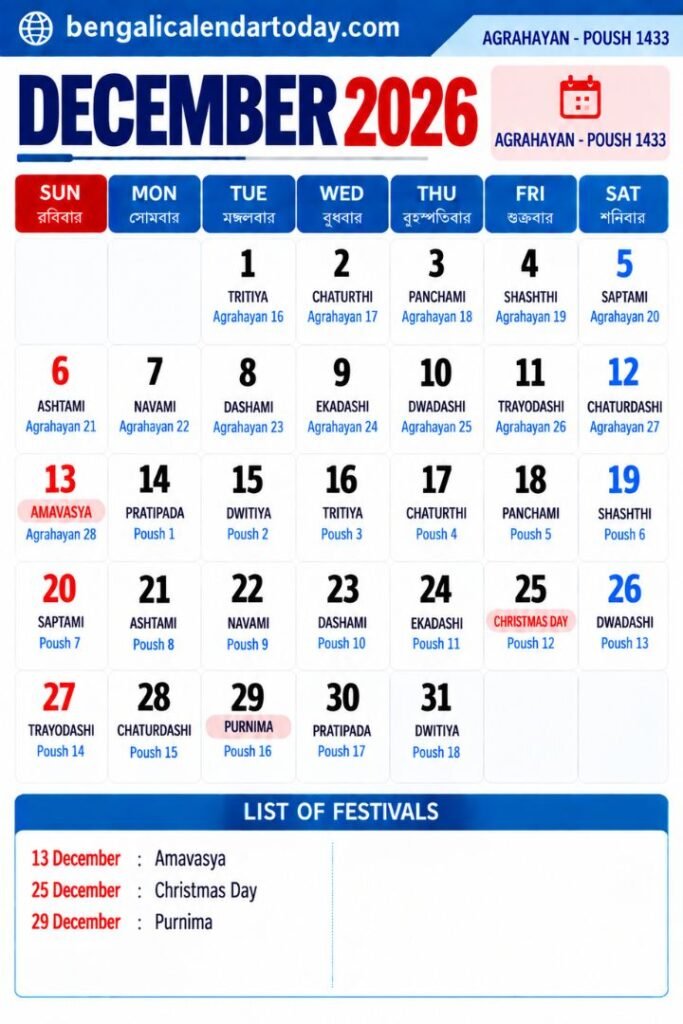
Bengali Calendar December 20266 closes out the Bengali calendar year with a mix of quiet devotion and genuine festivity. The month carries two Ekadashi fasts, an ancestor-honouring new moon, an important advisory around wedding season, the iconic Poush Mela at Shantiniketan, and Christmas — celebrated in Bengal as Boro Din — before the year winds down on December 31. Here’s every date laid out clearly, with what each one actually means for planning.
December 2026 Bengali Calendar — Full Month Table
| Date | Day | Festival / Observance |
|---|---|---|
| December 4, 2026 | Friday | Utpanna Ekadashi |
| December 8, 2026 | Tuesday | Agrahayan Amavasya |
| December 12, 2026 | Saturday | Second Saturday (bank holiday) |
| December 16, 2026 | Wednesday | Dhanu Sankranti — Poush begins, Kharmas starts |
| December 20, 2026 | Sunday | Mokshada Ekadashi & Gita Jayanti |
| December 23, 2026 | Wednesday | Agrahayan Purnima, Dattatreya Jayanti, Poush Mela begins |
| December 25, 2026 | Friday | Christmas Day (Boro Din) |
| December 26, 2026 | Saturday | Fourth Saturday (bank holiday) |
| December 31, 2026 | Thursday | New Year’s Eve |
Utpanna Ekadashi — December 4
The month’s first Ekadashi falls on Friday, December 4, in the waning fortnight of Margashirsha. According to the Bhavishya Purana, this is the day Goddess Ekadashi herself is said to have emerged from Lord Vishnu to defeat the demon Mura — which is where the name Utpanna, meaning “born” or “originated,” comes from. Many devotees treat this as the starting point for a year-long Ekadashi fasting practice, observing a full fast through the day and breaking it the following morning within the prescribed Parana window.
Agrahayan Amavasya — December 8
Tuesday, December 8 marks the new moon of the Agrahayan month, a day traditionally set aside for Pitru Tarpan — offering water and prayers to departed ancestors. Amavasya days carry particular weight in Bengali households for this kind of ancestral remembrance, and this one falls conveniently outside the main Pitru Paksha period, giving families who missed that window in the autumn another opportunity to observe it.
Dhanu Sankranti and the Start of Kharmas — December 16
This is the date worth circling if you have any life-event planning to do. On Wednesday, December 16, the Sun moves from Scorpio into Sagittarius, an event called Dhanu Sankranti that also marks the beginning of the Bengali month of Poush. Culturally, this is a welcome shift — Poush is a beloved winter month. Religiously, though, it opens the period known as Kharmas, during which weddings, engagements, Griha Pravesh ceremonies, and other major auspicious functions are traditionally avoided.
Kharmas runs until the Sun enters Capricorn at Makar Sankranti in mid-January 2027, so anything you’re hoping to schedule in this window — a wedding invitation already printed for late December, for instance — is worth rechecking against this date with your family priest or a local Panchang before finalising.
Mokshada Ekadashi and Gita Jayanti — December 20
Sunday, December 20 carries a rare double significance. Mokshada Ekadashi, whose name literally means “the one that grants liberation,” is considered one of the most spiritually potent fasting days of the year, believed to benefit not just the person observing it but their ancestors as well. The same date is Gita Jayanti, marking the anniversary of Lord Krishna’s discourse to Arjuna on the battlefield of Kurukshetra — the origin of the Bhagavad Gita. Temples across Bengal typically hold Gita recitations and discourses on this day, and many devotees use the occasion to read through some or all of the text’s eighteen chapters.
Agrahayan Purnima, Dattatreya Jayanti and Poush Mela — December 23
Three things converge on Wednesday, December 23. It’s the full moon of Agrahayan, considered favourable for charity and holy bathing. It’s also Dattatreya Jayanti, honouring Lord Dattatreya — worshipped as a single form combining Brahma, Vishnu, and Shiva, and revered as the archetypal guru figure, particularly in Maharashtra, Karnataka, and Andhra Pradesh.
For Bengal specifically, this is also the day the Poush Mela traditionally opens at Shantiniketan in Birbhum district. The fair traces back to 1843, when Maharshi Debendranath Tagore — Rabindranath Tagore’s father — formally embraced the Brahmo faith on this same full moon day, and an annual gathering grew from that occasion into the multi-day cultural fair now held on the Ashram grounds, drawing craftspeople, musicians, and visitors from across the region. Over the following days, the open fields around the Ashram fill with stalls selling terracotta work, handloom textiles, and traditional Bengali winter sweets, while Baul singers — the wandering minstrels of rural Bengal — perform late into the evening, giving the fair a character that feels closer to a folk gathering than a formal religious event.
Christmas — Boro Din, December 25
Friday, December 25 is a national public holiday, and in Bengal it goes by an affectionate name of its own: Boro Din, “the big day.” Kolkata’s connection to Christmas runs deep, a legacy of its colonial-era Christian community, and nowhere shows it better than Park Street, which is lit up for weeks around the holiday in a display that draws visitors of every background, not just the city’s Christian residents. Churches including St. Paul’s Cathedral hold midnight and morning services that are, in practice, attended by a genuinely mixed crowd — one of the clearer everyday examples of Kolkata’s religiously blended culture.
New Year’s Eve — December 31
The Bengali calendar year closes, as it does everywhere, with New Year’s Eve on Thursday, December 31 — restaurants, clubs, and public spaces across Kolkata and beyond filling up for the last night of the Gregorian year, even as the Bengali calendar itself continues on its own separate track into the new Bangabda year the following spring.
Frequently Asked Questions
When does Kharmas begin in December 2026, and when does it end? Kharmas begins on December 16, 2026, with Dhanu Sankranti, and runs until Makar Sankranti in mid-January 2027. Weddings and similar auspicious ceremonies are traditionally avoided throughout this period.
When is Gita Jayanti in 2026? Gita Jayanti falls on Sunday, December 20, 2026, coinciding with Mokshada Ekadashi.
When does Poush Mela begin at Shantiniketan? Poush Mela 2026 begins on Wednesday, December 23, alongside Agrahayan Purnima.
How many Ekadashi fasts fall in December 2026? Two: Utpanna Ekadashi on December 4 and Mokshada Ekadashi on December 20.
Is Christmas a public holiday in West Bengal? Yes. December 25, 2026 is a national public holiday, observed in Bengal as Boro Din.
What is Agrahayan Amavasya used for? It falls on December 8, 2026, and is traditionally used for Pitru Tarpan — offerings and prayers for departed ancestors, outside the main Pitru Paksha period.